
Hero names: full-game references versus the Demo
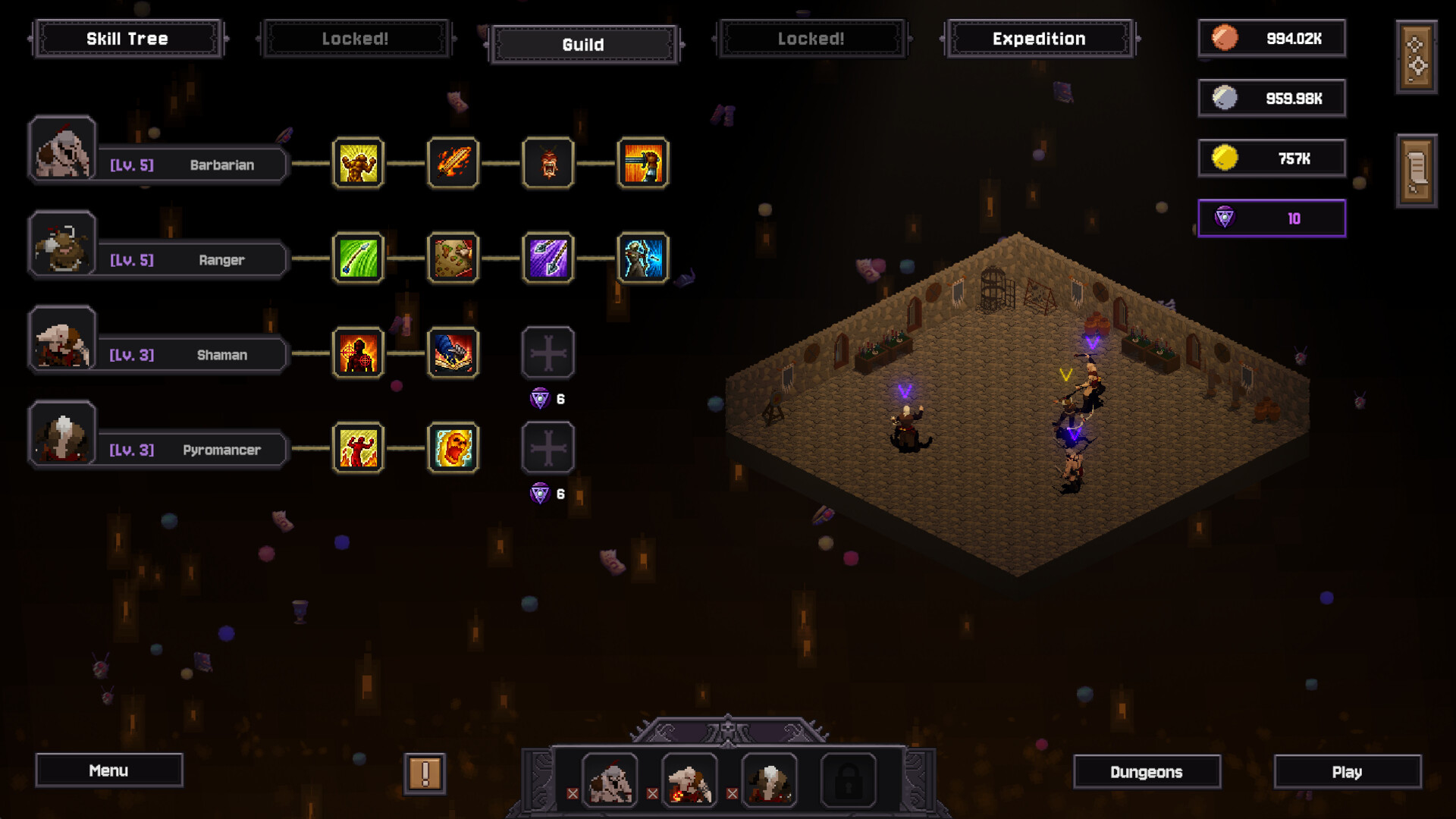
The official Guild image shows Barbarian, Ranger, Shaman, Pyromancer, Crusader, and Paladin. The Steam achievement list also names Ranger, Shaman, Pyromancer, Paladin, and Crusader. Use those references when identifying your full-game roster.
Older Demo notes include Archer and Wizard. Do not assume a Demo ability value or recruitment route applies to a differently named full-game hero. Exact hero unlock costs are not established by the achievement list.
Three ways to look for synergy
On a small screen, scroll the table sideways to see every column.
| Build idea | What to look for | What to compare |
|---|---|---|
| Team-wide critical chance | The Crusader’s King’s Decree is shown granting critical chance to the party over time. | Whether the benefit has time to build during your usual runs. |
| Attack-triggered summons | Royal Guard is shown with a chance to summon a knight when the Crusader attacks. | How often the trigger happens and whether summons improve clearing. |
| Room progression | The Paladin’s Expedition effect is shown awarding room XP on Expedition kills. | Whether room growth is more useful to you than the alternatives available. |
These are combinations suggested by the official tooltips, not measured damage rankings. A promising effect can still lose value if your runs are too short or your current setup does not support its trigger.
Meet the heroes shown in the full-game Guild
The launch announcement lists six recruitable heroes. Official Guild screenshots show Barbarian, Ranger, Shaman, Pyromancer, Crusader, and Paladin. Older Demo announcements use names such as Archer and Wizard, so match any advice to the names and tooltips in your build.
Begin by reading each unlocked hero’s choices. Ask what the effect needs to activate, who benefits, and whether your current room gives it enough time or targets to matter.
Compare two teams without guessing
- Choose a familiar room. Use it for both attempts.
- Keep your weapon and upgrades the same. Changing them would make the comparison harder to read.
- Swap one hero or one Blessing. Decide what you expect that change to improve.
- Compare equal lengths of play. Look at the resource you actually need, not just the biggest damage number.
- Repeat a close result. Random drops can make one run look better than the setup really is.
If you are choosing between a summon, an active effect, and a party buff, read the Blessings before spending.
Do not plan around slots you have not unlocked
Party capacity is part of progression. Build with the slots and heroes currently available, then revisit your setup when capacity grows. A guide that assumes a full roster is not a useful shopping list for your first few runs.
Write down one reason for each hero in your party. If two choices solve the same problem, try replacing one with an effect that supports the rest of the team.
QUICK QUESTIONS
Before your next run
What is the best team?
We do not have a verified best-in-slot team. Start with the effects you have unlocked, then compare teams in the room and version you actually play.
Why do some guides say Archer or Wizard?
Those names appear in older Demo announcements. The full-game promotional Guild screenshots show Ranger and Pyromancer. Do not assume old names and balance values match the current game.
Party slots, recruitment and expedition assignments
Recruiting a hero and buying another party slot are separate decisions. A explicitly adds their costs before bringing in another companion. Both runs also read the Expedition tutorial: a hero on an expedition cannot be in the active party at the same time.
Use an otherwise benched hero for an expedition when possible. If you move a strong fighter out of your party, compare the extra expedition income with what your active runs lose. The two creators make different early choices: A sends Ranger while retaining Barbarian; B sends Barbarian and fights with Ranger. Neither choice establishes a universal best hero.
Video A: 31:41–34:05, 57:11. Source notes.
Video B: 43:00–43:48. Source notes.
Party building: match buffs to the heroes receiving them
A chooses a Shaman effect described as buffing a random melee hero, while Barbarian is his melee damage dealer. Later he notices that replacing Barbarian changes the value of that choice. Read who receives a buff before copying a team.
Use total run rewards and clear speed alongside individual damage displays. A initially praises Shaman’s displayed number, then questions whether it is comparable to the other heroes’ DPS. The transcript does not resolve that display, so those numbers cannot support a Hero Tier List.
Video A: 1:12:33–1:13:00, 1:19:13–1:19:54, 2:02:59–2:06:15. Source notes.
Sources & scope
Gameplay video sources
A: Looting Millions of Skeletons for Upgrades! — Idle cub. B: This is a Powerful Incremental With a Guild! | Bones and Coins — Ash Swoon.
Gameplay examples are based on the video transcripts, reviewed September 8, 2026. A describes a full-game run; B introduces the game ahead of its September 7 release. Exact build numbers and video frames were not verified. Use current in-game tooltips for prices and balance.
Based on the full-release announcement, official store screenshots and game description, and clearly labeled Demo patch notes. Screenshots are examples, not live balance data.
Suggested comparisons and purchase decisions are editorial guidance, not playtested optimal routes. See how this guide was put together.
Found an error? Read the corrections policy with the page, game version, and supporting screenshot or source.