
Skill Tree progression and version differences
The Skill Tree supplies permanent upgrades, while a dungeon room has its own level progression. The current store overview says 160+ upgrades; the later release-plan announcement describes 180 skills. Those are different source snapshots, not two separate trees.
For your next purchase, compare the full path cost with the specific problem you need to solve. If the obstacle is a currency or ingredient, start with Currencies & Farming; if it is access to another destination, see Dungeon Rooms. A tested best-upgrade order is still needed before this guide can recommend exact nodes.
Use your bottleneck to set the priority
The launch announcement describes a Skill Tree with 180 skills and permanent upgrades. You do not need a plan for all of them before making your next useful purchase.
On a small screen, scroll the table sideways to see every column.
| Your problem | Look for | Watch out for |
|---|---|---|
| Enemies take too long to clear | An available effect that improves the weapon or heroes you are using. | Buying a bonus for a different setup because its number looks large. |
| The next purchase needs more coins | Relevant income effects, suitable room rewards, and available Expedition options. | Spending the exact currency you were saving without checking the payoff. |
| A forge needs materials | The room and enemies that supply your missing ingredients. | Treating a material shortage as a reason to buy unrelated damage upgrades. |
| A new build needs another hero | Your current recruitment and party-capacity requirements. | Planning around a slot you cannot use yet. |
This is a decision framework, not a tested optimal route through the tree.
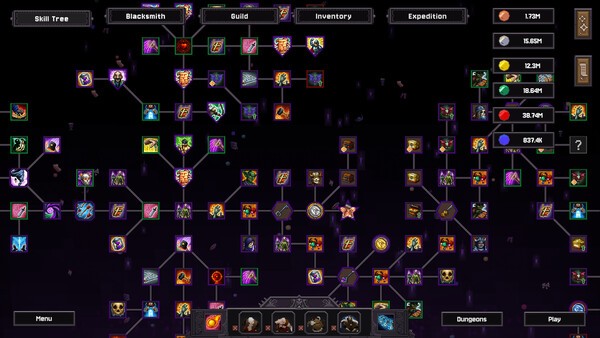
Price the whole path, not just the destination
Before saving for a distant node, check the prerequisites between you and it. The meaningful cost is everything you must buy to reach the effect, including the currencies those earlier purchases use.
Compare that path with one nearer improvement from the Blacksmith or Guild. If the distant effect supports a build you have not unlocked, a purchase that helps your current runs may be more useful now.
For income upgrades, think in payback time
An income upgrade is easier to judge when you know what it costs and how much extra currency it actually earns. Compare equal periods in the same room before and after the purchase.
Payback time ≈ upgrade cost ÷ extra coins earned per minute
Use the same currency on both sides. For example, a hypothetical 1,000-coin upgrade that adds 100 coins per minute takes about 10 minutes to earn back. These are illustrative numbers, not Bones and Coins balance data. If the upgrade also unlocks another system, that benefit needs a separate judgment.
Avoid changing the whole build at once
Buying several effects, switching weapons, and replacing a hero at the same time makes it hard to tell what helped. If you want to learn which purchase pays off, keep the next comparison simple.
Old Demo costs are another trap. The v0.8.0 patch changed Skill Tree nodes and costs, while the full release expanded the tree again. Follow current tooltips over a dated shopping list.
Pick one available node, write down the improvement you expect, and compare it with your next weapon or hero purchase before spending.
QUICK QUESTIONS
Before your next run
Is there one best Skill Tree order?
We have not verified a universal order. Your available branches, currencies, heroes, and current bottleneck all affect the next useful purchase.
Are Skill Tree upgrades permanent?
The full-release announcement describes permanent Skill Tree upgrades. That does not establish whether every choice can be refunded; check the current game before assuming a reset is available.
Best upgrades: choose by your current bottleneck
| What is happening? | What to compare next | Why |
|---|---|---|
| You clear the screen with time left | Initial skeleton count, continuous spawning and respawn-on-kill nodes | More available targets can let existing damage keep earning. |
| Enemies remain alive when the torch ends | Weapon damage, attack speed, a forge or a useful ability | Adding more enemies does little if the current group is already too slow to kill. |
| The next purchase needs a specific coin | That currency’s unlock and coin-value upgrades | A larger balance in another currency does not pay its cost. |
| A recruited hero has nowhere to go | Party-slot cost alongside recruitment cost | Recruitment alone does not increase active party capacity. |
| A weapon is blocked by materials | Item-drop access, collection and the relevant enemy or room | Check the missing ingredient before buying another general damage node. |
These are decision rules drawn from the runs, not a fixed fastest route. A repeatedly improves coin value and enemy supply early, then changes priorities when a weapon or party slot becomes the bottleneck. Include prerequisite nodes in the price of your next goal.
Video A: 02:34–05:03, 13:32–18:31, 57:11. Source notes.
Ability upgrades: equip the spell before comparing it
A finds that unlocking a second spell does not automatically replace the selected one. Check your ability slot before deciding an unlock had no effect. The runs also discuss separate upgrades for cooldown, duration, area, repeat casts and random triggers; these affect different parts of a spell’s performance.
Change one part at a time in a familiar room. A describes the whirlwind grouping enemies before Barbarian attacks, but this is a recorded combination to try, not proof that the spell is always better than Arrow Rain.
Video A: 40:25–42:01, 1:00:02. Source notes.
Video B: 1:18:23–1:19:08. Source notes.
Sources & scope
Gameplay video sources
A: Looting Millions of Skeletons for Upgrades! — Idle cub. B: This is a Powerful Incremental With a Guild! | Bones and Coins — Ash Swoon.
Gameplay examples are based on the video transcripts, reviewed September 8, 2026. A describes a full-game run; B introduces the game ahead of its September 7 release. Exact build numbers and video frames were not verified. Use current in-game tooltips for prices and balance.
Based on the full-release announcement, official store screenshots and game description, and clearly labeled Demo patch notes. Screenshots are examples, not live balance data.
Suggested comparisons and purchase decisions are editorial guidance, not playtested optimal routes. See how this guide was put together.
Found an error? Read the corrections policy with the page, game version, and supporting screenshot or source.